
You do not need a shelf of porcelain before you can brew a decent cup of tea. What you need is a small set of tools that remove guesswork: something to brew in, a way to control heat, a way to measure leaf, and a place to keep tea fresh. Everything else is optional, and most of it can wait.
Think of this as a starter kit you build over a few weeks rather than buy in one cart. Below is what earns its counter space, what can wait, and a checklist to keep at the back of your tea notebook.
Pick a Brewing Vessel You Will Actually Use
The single most useful purchase for a new drinker is a small gaiwan — usually 90 to 120 millilitres, in porcelain or glass. It is inexpensive, it works for green, oolong, black and pu-erh alike, and the lid lets you control the pour. Because the walls are pale and thin, you also see the leaves open, which teaches you more in a month than any guide will.
A small teapot, 150 to 250 millilitres, is the better choice if you usually brew for two or want to pour without thinking about it. Keep it glazed inside rather than unglazed clay; unglazed pots hold onto the flavours of whatever you brew first, which is not what you want while you are still exploring.
For rushed mornings, a simple mug with a wide basket infuser is fine. What you want to avoid is the small ball-shaped infuser that clamps shut. Leaves need room to expand, and a cramped ball traps them in a tight knot that never brews evenly.
Two extras that cost almost nothing
- A small tray or folded tea towel to catch drips. Brewing gets messy, especially at first.
- A second cup, ideally identical to the first, so you can taste two teas side by side.
Get Serious About Heat and Measurement
Water temperature and leaf quantity do more to change your tea than the pot ever will. A variable-temperature kettle is the easiest way to control this. If you already own a stovetop kettle, a simple kitchen thermometer works just as well and costs very little.
As a rough map: greens and young whites like water around 70 to 85°C, oolongs generally 85 to 95°C, and blacks and pu-erhs close to boiling. If your tea tastes bitter and drying, the water was probably too hot or the steep too long. If it tastes flat and thin, the opposite.
A digital scale reading to 0.1 grams is worth more than it sounds. Scoops vary wildly depending on leaf shape — a fluffy white tea and a dense rolled oolong occupy completely different volumes at the same weight. Start around 1 gram of leaf per 15 to 20 millilitres of water for repeated short steeps, and about 2 to 3 grams per 250 millilitres for a single mug.
The rest of the counter kit
- Timer. Your phone is fine. Short steeps of 10 to 20 seconds matter.
- Fine mesh strainer. Necessary for teapots and for catching leaf fragments in the cup.
- Small pitcher or spare cup. Lets you pour off the whole brew so leaves stop steeping.
Storage Is Not an Afterthought
Tea goes stale quietly. Light, heat, air and strong smells are the four things working against it, so storage should block all of them. Buy opaque, airtight tins rather than glass jars, and keep them in a cupboard away from the stove, the window and your spice rack.
Smaller containers are better than one big one. Every time you open a large tin you exchange the air inside, so decanting a month's worth into a smaller tin keeps the rest fresher. Buy 50 to 100 grams at a time while you are learning what you like.
Skip the fridge for most teas. Odours migrate into leaf easily, and condensation from repeated trips in and out does real damage. If you buy green tea in quantity, seal it completely and let it come to room temperature before opening — but it is simpler to buy less of it more often.
Tools That Train Your Palate
Tasting tools are cheap and they change how fast you learn. You need a pale, thin-walled cup so you can judge colour, a notebook, a teaspoon for handling dry leaf, and the thermometer and scale you already have.
Then borrow a habit from professional cuppers and taste in pairs:
- Brew two teas with the same leaf weight, temperature and timing.
- Smell the wet leaf before you drink. Most of what you taste begins here.
- Note the first impression, the middle, and the finish — separately.
- Write down the numbers, not just the verdict: leaf weight, water temperature, steep times.
That last step is the one people skip, and it is the reason six months later they cannot remember why one tea worked and another did not. A few lines per session is enough. Note what you tasted in plain words: creamy, brisk, grassy, drying, sweet at the back.
The Printable Starter Kit Checklist
Copy this into a notebook or print it and tick items off as you go. Buy in this order and you will never spend on something you do not use.
- Brew: 100ml gaiwan or 200ml glazed teapot
- Brew: basket infuser mug for busy mornings
- Brew: small pitcher or spare cup for pouring off
- Heat: variable-temperature kettle, or thermometer
- Measure: 0.1g digital scale, timer, teaspoon
- Pour: fine mesh strainer, tray or tea towel
- Store: two or three small opaque airtight tins
- Store: a cool, dark cupboard shelf with room to spare
- Taste: two pale, thin-walled cups of the same size
- Taste: notebook and pen kept with the tea
- Clean: soft cloth, and no soap on porous ware
What You Can Safely Skip
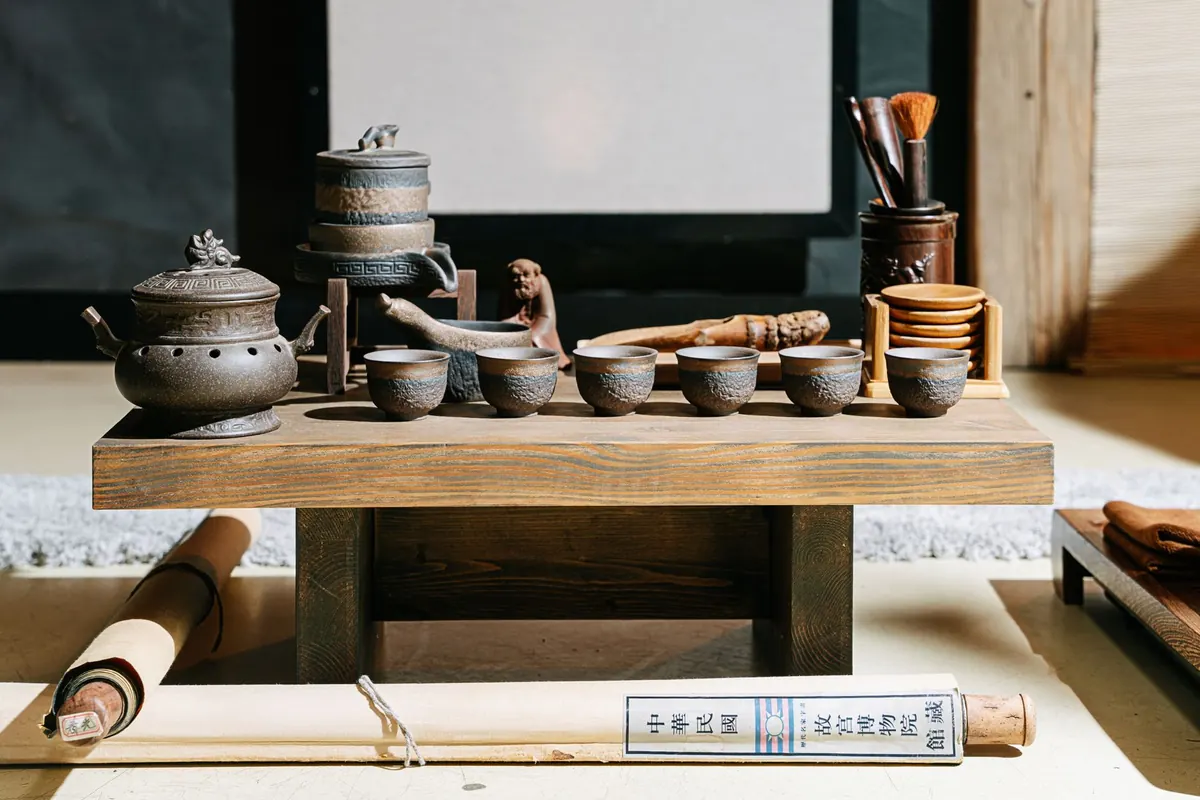
You do not need a matching gongfu set with a dozen pieces, a carved tea table, a tea pet, or an unglazed clay pot dedicated to a single tea. Those are lovely later, and they make less sense before you know what you drink.
Also skip the enormous sampler of twenty flavours. Flavoured blends can be enjoyable, but heavy added fruit and oil residue lingers in brewing vessels and masks the base tea while you are still learning to recognise it. Pick four or five unflavoured teas across different types instead: one green, one oolong, one black, and something aged or roasted if you are curious.
One more caution worth stating plainly: if you take medication, are pregnant, or have a condition affected by caffeine, talk to a healthcare professional about how much tea fits your situation rather than relying on general advice.
Build It Slowly, and Drink as You Go
Start with a gaiwan, a thermometer, a scale, two tins and a notebook. That is a complete kit. Use it for a month, notice what annoys you, and let those annoyances tell you what to add next — a bigger pot because you keep brewing for friends, a second gaiwan because you keep comparing teas. The best starter kit is not the most complete one. It is the one sitting on your counter, already warm.
Photo: Ivan S / Pexels